
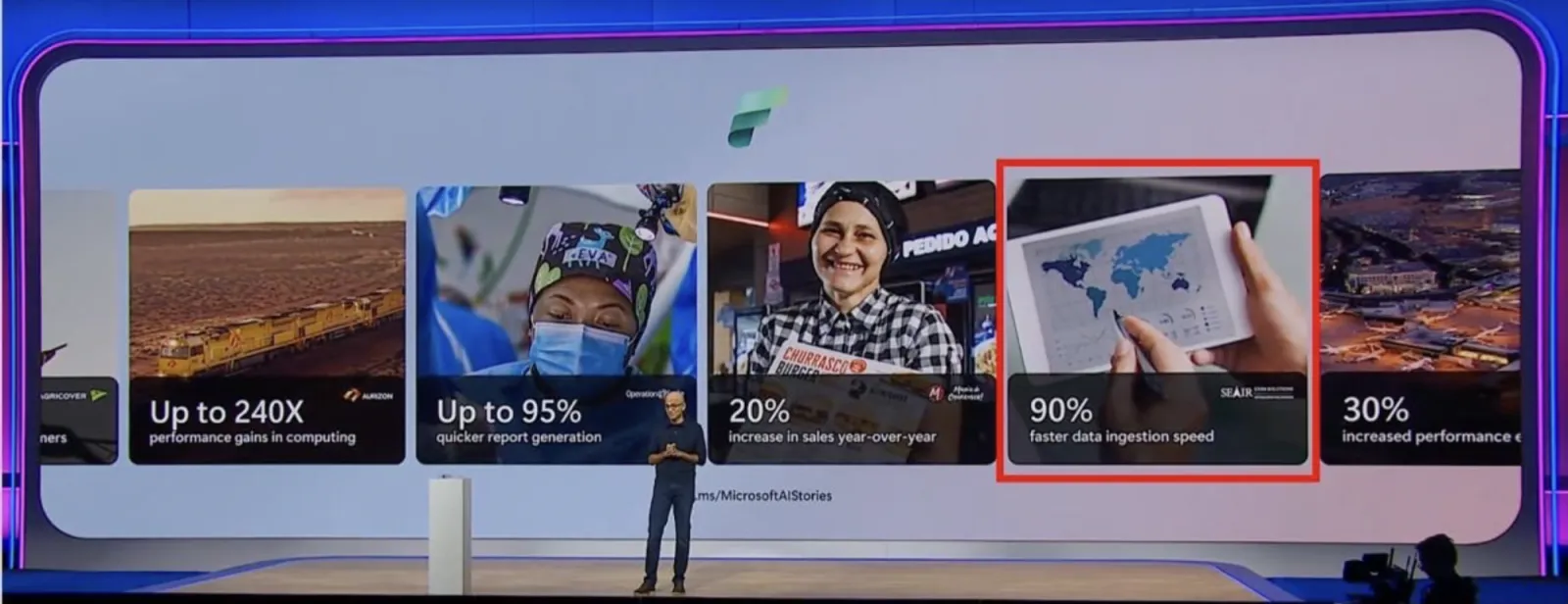
Satya Nadella featured a customer story built by Mandelbulb Technologies during his Microsoft Ignite 2024 keynote, with one number on the screen behind him: 90% faster data ingestion.
The story was Eximpedia, the trade-intelligence platform run by Seair Exim Solutions, which we rebuilt on Microsoft Fabric and Azure OpenAI. For a team headquartered in Jaipur, watching our work appear in a Microsoft CEO keynote alongside global enterprise stories was a particular kind of validation. This is the full account: what we built, what it changed, and why CEO-stage recognition is the credential that is hardest to manufacture.
What was on the keynote screen
Microsoft Ignite is the company's premier technology conference, attended by thousands of developers, architects, and enterprise leaders. During the keynote, the Seair Exim Solutions tile appeared on the Microsoft AI Stories wall behind Nadella, among a set of global enterprise stories, carrying the headline metric "90% faster data ingestion speed."
A keynote customer story is not bought. Microsoft selects it. When the CEO personally puts a partner-built deployment in front of that audience, it is the highest level of recognition in the Microsoft ecosystem, and it is editorial rather than transactional. That is what makes it worth more than any badge.
The customer: Eximpedia, and the wall it hit
Seair Exim Solutions is a global export-import trade-data provider. Its platform, Eximpedia, serves roughly 24,000 customers across more than 100 countries and handles around 200,000 queries a day. Launched in 2021, it had grown faster than the infrastructure underneath it.
The backend ran on AWS with ElasticSearch. As customers asked for more data columns and richer real-time visualizations, system updates degraded performance. Searches that should have returned in milliseconds were taking 5 to 20 seconds, and updates had to be scheduled at night and on weekends to avoid disrupting customers. Underneath the speed problem sat a harder one: half a billion supplier records that no two source systems spelled the same way.
What we built on Microsoft Fabric
Mandelbulb recommended and executed a complete migration of Eximpedia to Azure and Microsoft Fabric. The new platform runs on Eventhouse with Kusto Query Language (KQL) databases wired directly into Power BI for data and reporting.
We completed the migration in two months with 100% data integrity, using a staging layer for verification and a data lake for accuracy checks, so the cutover never put customer trust at risk. The result was not a faster version of the old platform. It was a real-time one, and a foundation we could put AI on top of.
The AI layer that made Seair a first mover
Seair was among the companies Microsoft recognized as AI first movers in India, the cohort that moved to production AI early rather than waiting for the category to settle. Three pieces of AI work earned that standing.
Data reconciliation with Azure OpenAI.
Standardizing more than half a billion supplier records was the kind of task conventional methods could not handle at scale, because the same supplier appears under different names, missing fields, and conflicting addresses across customs declarations. Azure OpenAI reconciled 500,000 unique supplier records at 99% accuracy in a two-week proof of concept, for a single country and trade type, and that approach now runs across the platform’s full coverage of 100+ countries.
Real-time natural-language querying.
With Microsoft Fabric and Azure OpenAI together, Eximpedia users can now search trade data the way they search the web, in plain language. The result is conversational data exploration, instant visualizations, and trend analysis across billions of records, returned in under a second.
Faster engineering with GitHub Copilot.
GitHub Copilot accelerated the build itself, reducing errors and letting the engineering team ship new features faster, so the platform could scale without the headcount that pace would normally demand.
First-mover advantage in AI is rarely about the model. It is about getting the data architecture right first, then putting AI where it changes the customer experience, which is precisely the work that earned this story its place on the keynote.
The results Microsoft put on stage
The case study was published on Microsoft’s customer-stories site and selected for the Ignite keynote. The verified outcomes:
90% faster data processing, the figure shown on the keynote screen
Under 1 second to query billions of records, down from 5 to 20 seconds
99% accuracy reconciling 500M+ supplier records with Azure OpenAI
52% lower operational costs
37% increase in search activity and user interaction
27% annual increase in client retention
2 months to migrate, with 100% data integrity
Read our full Seair Exim case study, or the verified customer story on Microsoft.com (opens in a new tab).
Why this is the recognition that matters
CEO-stage recognition sits on top of a deeper Microsoft partnership track record:
Microsoft Fabric Featured Partner, 3x consecutive (Ignite, Build, Fabric Community Conference)
Microsoft Partner of the Year 2024 Finalist, Analytics Award
Solution Partner: Data & AI Azure, Digital & App Innovation, Infrastructure
Advanced Specialization: Analytics on Azure
Azure Data Explorer Partner, one of only 37 globally
Elite Partner Voice Program member and ISV Partner
From real-time intelligence for Swiggy's 23 million monthly users (see the Swiggy case study) to Seair's global trade platform on Microsoft Fabric and Azure OpenAI, the throughline is production-grade data engineering and AI that Microsoft is willing to put its own name behind.
Nadella's keynote did not change what we do. It confirmed it: the data and AI work that earns a place on the world's biggest software stage can be built from India, for customers anywhere. If you are deciding whether to move your own data platform to Microsoft Fabric, that is the question worth starting from.
Filed under